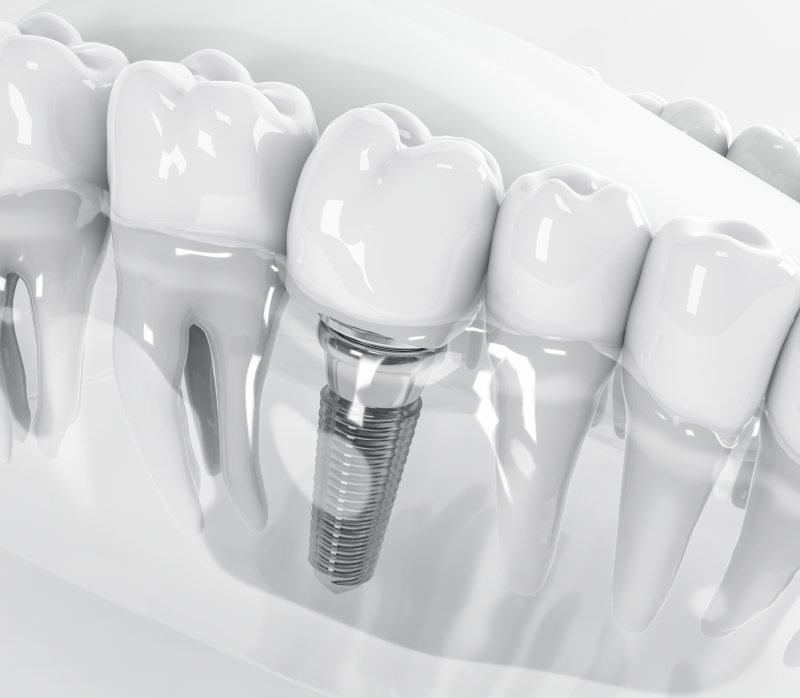
It is possible to restore teeth without implants: options include a fixed bridge supported by adjacent natural teeth or a removable denture — made of nylon, acrylic or a clasp-retained denture. However, at FrankoLab, we generally recommend dental implants. Only an implant replaces not just the crown, but also the tooth root. It does not require the adjacent teeth to be ground down and helps to preserve the bone.
Options without implants make sense when implantation is not currently possible, or as a temporary step prior to it. Below, we provide an honest comparison of all the options so that you can see the difference.
Approximate prices at FrankoLab: an implant — from 14,970 ₴, a crown on an implant — from 8,982 ₴. A metal-ceramic bridge for 3 teeth — from 22,455 ₴, a nylon denture — from 14,970 ₴, a clasp denture — from 54,890 ₴. The dentist will provide an exact quote following a consultation.
Why we still recommend dental implants
During consultations, we are often asked: ‘Is it possible to avoid implants?’ The reasons are understandable: budget, fear of surgery, and a desire to consider all options. We always present these options. However, the comparison usually favours implants:
| Dental implant with a crown | Bridge | Removable dentures | |
|---|---|---|---|
| Adjacent teeth | Leave it as it is | We prepare teeth for crowns, even healthy ones | We do not grind down teeth, but clasps put pressure on them |
| Bone at the site of the tooth | It withstands the load, so it lasts longer | Gradually decreasing | It is gradually wearing down; the prosthesis needs to be adjusted |
| How it feels | Just like a natural tooth | It’s fixed, but it’s harder to clean underneath it | You need to have them removed, cleaned and get used to them |
| Price per tooth | from 14,970 ₴ + crown from 8,982 ₴ | from 22,455 ₴ (3 units) | from 12,475 ₴ |
If a single tooth is missing, the cost of an implant with a crown is comparable to that of a bridge. The difference is that the neighbouring teeth do not ‘pay’ for the implant. A detailed comparison can be found in the article ‘Implant or bridge: which is better?’. If all the teeth in the jaw are missing, an alternative to a full removable denture is All-on-4: fixed teeth supported by 4 implants.
A glimpse into the laboratory. Every day I see restorations being returned for rework. Most often these are old bridges, where the supporting teeth have deteriorated, and removable dentures that no longer fit properly because the gums have changed. We also fabricate implant-supported restorations every day. Their advantage is that they are not dependent on the condition of the adjacent teeth.

Find out more: dental implants · implant-supported prosthetics.
When a treatment option without implants is appropriate
- the dentist identifies any contraindications to implantation, whether temporary or permanent;
- the gap needs to be closed quickly whilst the socket heals or the bone is being prepared;
- it is not currently possible to have an implant fitted, and you are planning to have one fitted at a later date;
- If the adjacent teeth are already fitted with crowns or are severely damaged, and need to be covered anyway, then a bridge may be a sensible solution.
A ‘no implants’ solution is not necessarily final. You can start with a removable denture and switch to implants later. It is important to draw up a plan straight away so that nothing has to be redone.
Options without implants: in brief
| Option | When is it suitable? | What about the neighbouring teeth? | How it feels | Price from |
|---|---|---|---|---|
| Bridges (metal-ceramic or zirconia) | One or two adjacent teeth are missing, with healthy teeth on either side | The abutment teeth are prepared for crowns | Fixed | 22,455 ₴ (3 units, metal-ceramic) |
| Nylon denture | Several teeth are missing; a simple or temporary solution is required | No grinding required; held in place by flexible clasps | Removable, soft, lightweight | 14 970 ₴ |
| Acrylic denture | Many or all teeth are missing from the jaw | No grinding | Removable, sturdier and more substantial | 12 475 ₴ |
| Clasp-retained denture | Several molars are missing, particularly at the back of the row | No tooth structure is removed; the load is distributed across the teeth and gums | Removable, with a thin metal framework | 54 890 ₴ |
| Immediate prosthesis (temporary) | During the healing period or prior to implantation | No grinding | Removable, short-term | 6 487 ₴ |
Bridges: a permanent solution on your own teeth
A bridge consists of several crowns joined together to form a single structure. The outer crowns are fixed to the adjacent (‘abutment’) teeth, whilst the middle one replaces the missing tooth. In order for the crown to be fitted onto the abutment tooth, the tooth is ground down.
Pros: there’s no need to remove the bridge, and it’s easy to get used to.
What you need to know:
- The grinding down of healthy teeth is irreversible;
- The supporting teeth bear the load for the missing tooth as well, so the dentist assesses their condition from an X-ray;
- the bone beneath the intermediate section of the bridge gradually recedes over time;
- You need to clean thoroughly under the bridge: using a water flosser or special dental floss.
From the laboratory. We manufacture bridges from metal-ceramic or zirconia. Zirconia is light-coloured on the inside, so there is no dark line visible at the gum line, as with older metal-ceramic bridges. The price of a bridge is calculated per unit: a metal-ceramic crown starts at 7,485 ₴, and a zirconia crown starts at 12,475 ₴. We explain what to do with an old bridge in the article ‘The old bridge is wobbly: what to do with metal-ceramic bridges’.
Find out more: fitting dental bridges.
Nylon dentures: lightweight and metal-free
Nylon dentures are made from a flexible, gum-coloured material. They are held in place on the teeth by soft clasps of the same colour, so no metal hooks are visible.
Advantages: lightweight, does not wear down the teeth, you get used to it quickly, suitable for people with metal allergies.
What you should know: due to its flexibility, nylon ‘bounces’ slightly when chewing and exerts greater pressure on the gums. It is therefore better suited to small gaps or as a temporary solution prior to implantation. The prosthesis should be removed at night and after meals, and cleaned daily.
From the laboratory. Nylon is difficult to repair and re-base (to adapt to the gums, which change over the years). If you are due to undergo treatment or have neighbouring teeth removed, please inform your dentist in advance.
Find out more: nylon dentures.
Acrylic dentures: when many teeth are missing
A rigid acrylic denture. It is held in place by clasps, and if there are no remaining teeth, it adheres to the gums and palate. This is usually the most affordable way to restore a full set of teeth.
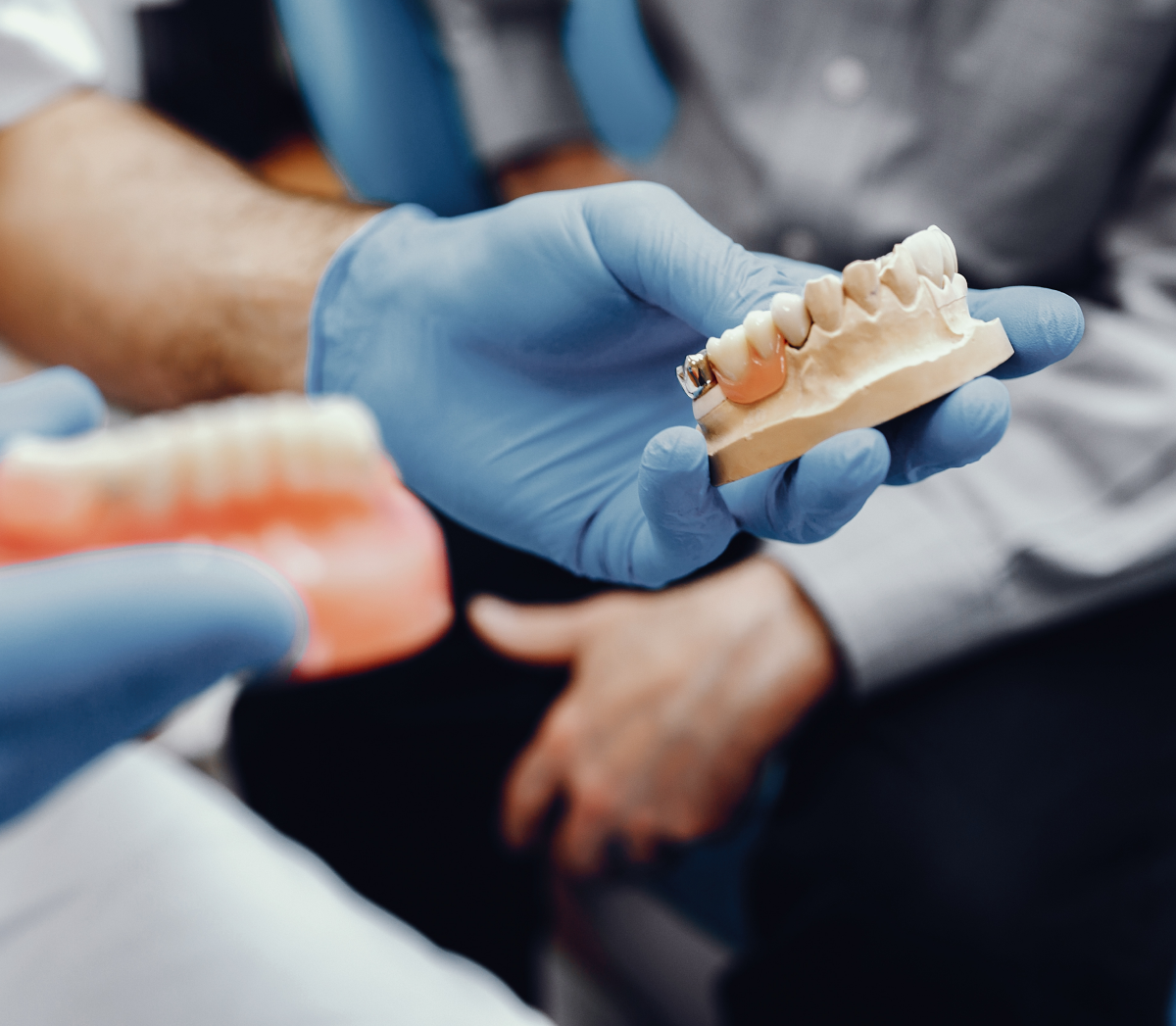
What you need to know: it is bulkier than the others, so it takes some getting used to – the feel in your mouth, speaking and chewing. On the other hand, acrylic is easy to repair and reline (from 3,742 ₴). The option with an aesthetic set—that is, with more natural-looking teeth—costs from 18,962 ₴. If you are missing all your teeth, compare this option with All-on-4: the difference in comfort is significant.
Find out more: acrylic dentures.
Clasp-retained denture: the most stable type of removable denture
The basis of a clasp denture is a thin cast metal framework (arch) to which artificial teeth are attached. It rests on both the patient’s own teeth and the gums, so the chewing load is distributed more evenly. On the upper jaw, it does not cover the entire palate.
Advantages: stable whilst chewing, more comfortable than acrylic. Suitable when several molars are missing at the end of the arch and there is nothing to anchor a bridge to.
What you should know: this is the most expensive type of removable denture. It is made in several stages, including fittings. The clasps are sometimes visible when you smile, so the dentist will discuss their placement with you in advance. It is also worth noting that, in terms of cost, a clasp-retained denture is comparable to two implants with crowns.
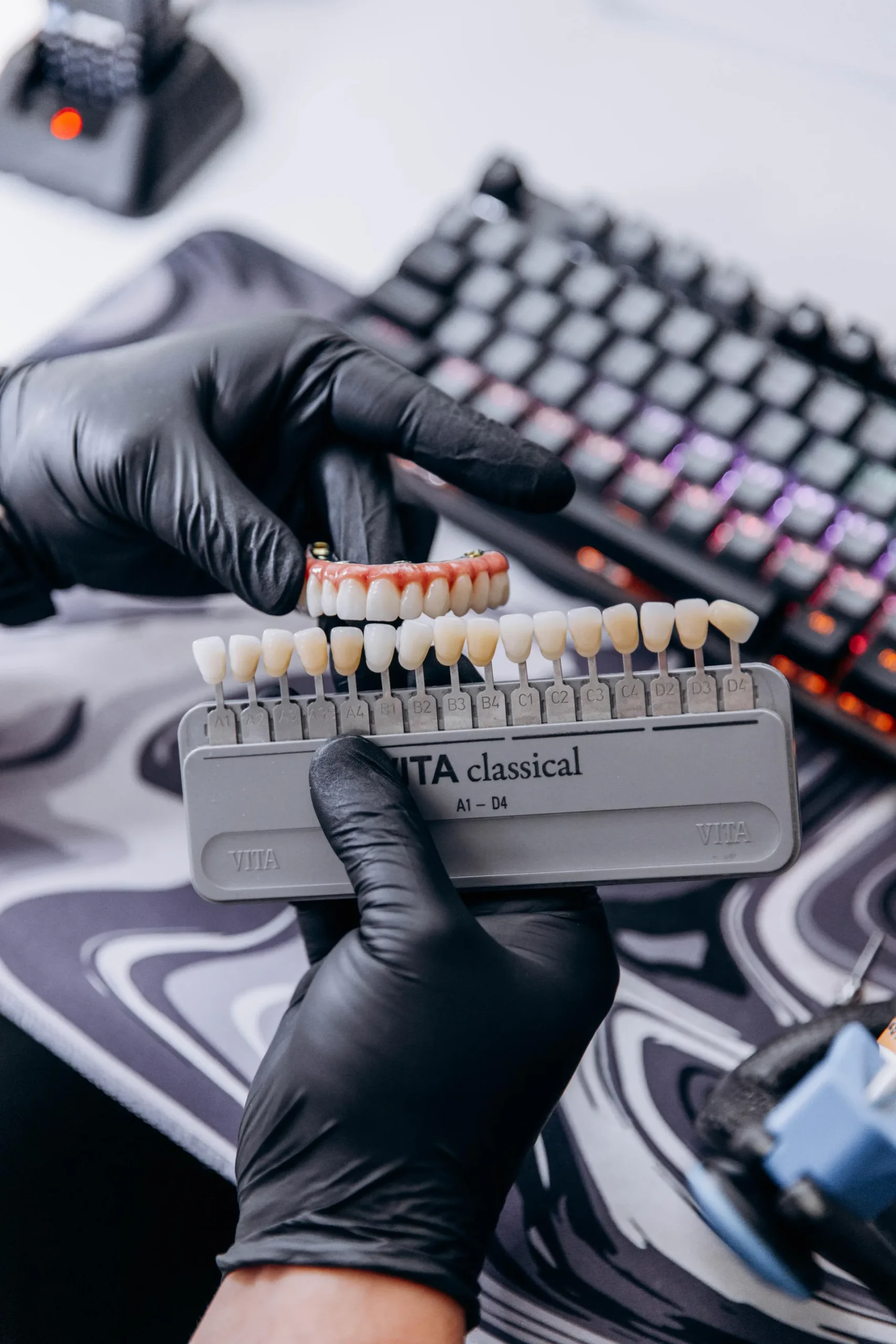
From the laboratory. The framework is custom-made to fit your teeth. How securely the prosthesis fits depends on the accuracy of the impression or scan, so fittings are not just a formality.
Find out more: removable dentures.
How long does each option last?
Lifespan depends on care, bite, gum health and regular check-ups. Approximate figures:
- Bridges — usually 10–15 years, provided the supporting teeth are healthy and well looked after;
- clasp denture — approximately 5–10 years, with periodic adjustments;
- Acrylic and nylon — approximately 3–5 years: as the gums and bone change, the denture needs to be adjusted or replaced.
We explain what determines the lifespan of an implant in a separate article entitled ‘How long do implants last?’. During your consultation, the dentist will explain exactly what you can realistically expect in your particular situation.
How we select solutions
- Examination and CT scan. The dentist assesses the teeth, gums and bone. They determine whether implant placement is possible and which teeth can serve as anchors.
- A plan with options and prices. First, we suggest the solution we believe is best for you in the long term. Most often, this is dental implant treatment. We list alternatives alongside this, highlighting their pros and cons.
- Manufactured in our own laboratory. We create the restoration on site, so the dentist and technician work together, and fittings and adjustments are carried out promptly.
- Follow-up. We’ll check how you’re getting on with your new restoration and make any necessary adjustments.
If you live in another city or abroad, start with a free online consultation. Based on a photo and an X-ray, the dentist will tell you whether an implant is possible and how many appointments will be required.
Frequently Asked Questions
Why do you recommend an implant when a bridge could be fitted?
A bridge requires the adjacent teeth to be ground down, even if they are healthy, and the bone beneath it recedes over time. An implant replaces both the root and the crown, does not affect neighbouring teeth and helps to preserve the bone. If a single tooth is missing, the cost of both solutions is comparable.
Is it possible to have a bridge fitted if several teeth in a row are missing?
If one or two teeth are missing and the supporting teeth are strong, this is usually the case. When the gap is longer, the load on the supporting teeth is too great. In that case, the dentist will recommend implants or a removable denture.
Which is better: a nylon denture or a clasp denture?
Nylon is lighter and cheaper, and is well suited to small gaps and as a temporary solution. A clasp-retained bridge is more stable when chewing, particularly when several molars are missing. If dental implants are an option, the dentist will suggest comparing both options with implants.
Is it possible to have implants fitted later if I have a denture fitted now?
Yes, a removable denture does not prevent future implant treatment. However, the longer a tooth is missing, the more the bone may recede. It is therefore best not to delay for too long: your dentist will advise you on the best timeframe.
How long does it take to get used to a removable denture?
It usually takes anywhere from a few days to a few weeks. If your dentures are rubbing or causing discomfort, don’t put up with it: they can be adjusted.
Would you like to find out if dental implants are right for you? Book a consultation. The dentist will assess your situation, explain all the options and give you an exact quote. The decision is made together with the dentist, not on your behalf.