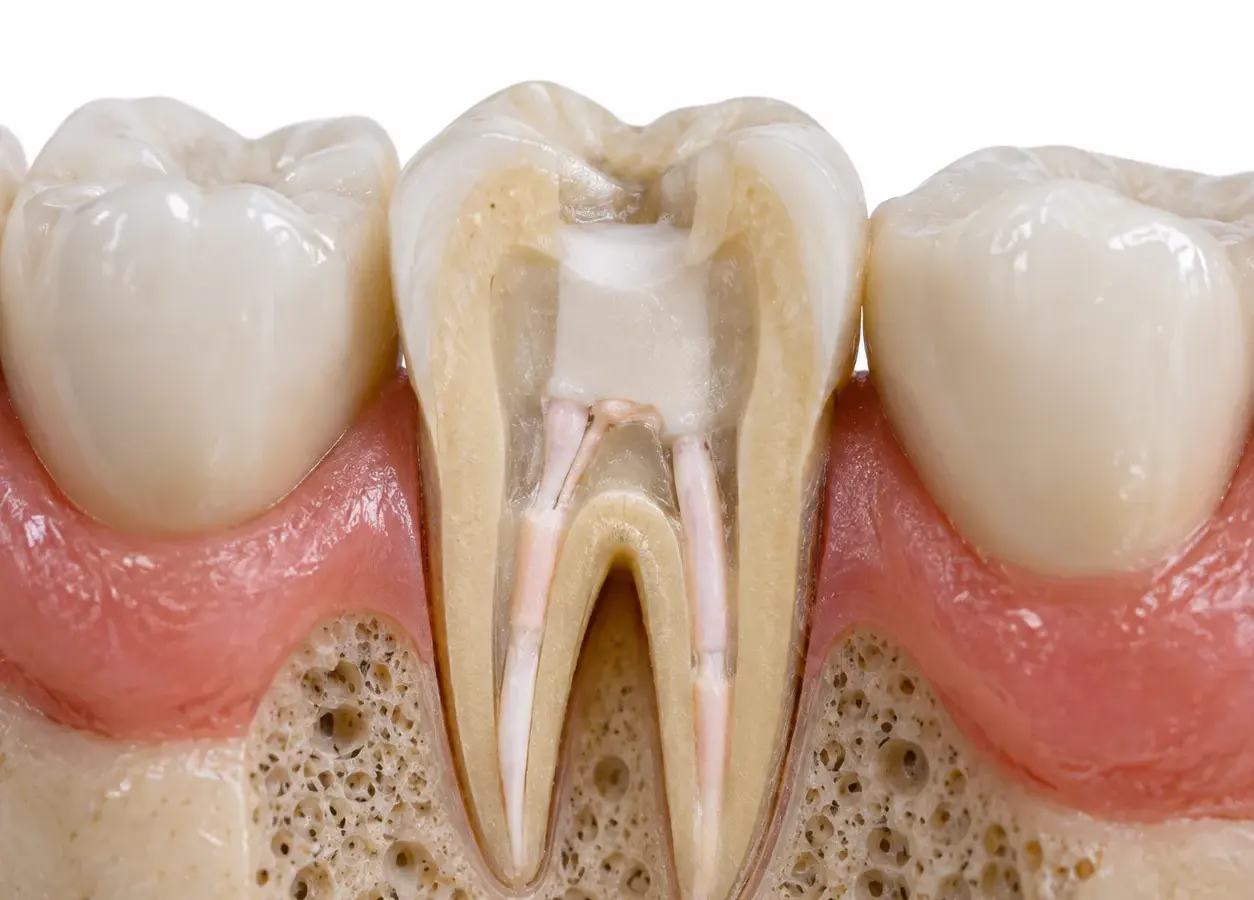
A tooth that has had its pulp removed — a tooth without a nerve — often darkens from the inside over time: the enamel takes on a grey, yellow or brown tint, which spoils the aesthetics of the smile even after high-quality root canal treatment. The cause is the breakdown products of the pulp and the oxidation of blood residues in the dentinal tubules. Standard external whitening does not help in such cases, as the discolouration originates from within.
Intracanal tooth whitening is a cosmetic dental procedure in which the whitening agent is placed directly into the tooth’s pulp chamber, acting on the pigments from within. Intracanal whitening makes it possible to lighten a ‘dead’ tooth by several shades without the need for grinding or fitting a crown or veneer. The specialists at FrankoLab Clinic offer intracanal tooth whitening as a minimally invasive and highly effective cosmetic solution.
Tooth discolouration following root canal treatment
Intracanal bleaching makes it possible to lighten a tooth from the inside when, following endodontic treatment, the crown changes colour due to residual pulp, haemorrhage or materials used during root canal filling.
Discolouration resulting from dental trauma
The procedure helps to remove internal dentine discolouration caused by a blow resulting in bleeding into the pulp chamber. The whitening agent acts directly inside the tooth and restores its natural shade.
Discolouration due to pulp necrosis
Following high-quality root canal treatment, in-canal bleaching makes it possible to correct the colour of a tooth that has darkened due to pulp decay and to restore its appearance without the need for a prosthetic restoration.
Staining of dentine by residual endodontic materials
This method is effective when a tooth has discoloured due to old filling materials (such as resorcinol-formalin paste) or other substances that have penetrated the dentine. Internal bleaching helps to reduce or eliminate such discolouration.
Aesthetic colour correction of a pulpless tooth
Intracanal bleaching is used to ensure that one or more depulped front teeth match the colour of the adjacent natural teeth. It is a minimally invasive alternative to veneers and crowns.
Prices for in-office teeth whitening
The cost of in-office teeth whitening at FrankoLab Clinic in Ivano-Frankivsk depends on the number of sessions required, the condition of the tooth and the extent of the final filling and restoration. We provide a transparent quote following a consultation and diagnosis, with no hidden additional charges during treatment. If required, payment plans are available with no extra charges – please check the terms and conditions with our administrator.
The dentist will quote the final cost following an examination and diagnosis. Payment in instalments is available. Full price list for the clinic
Stages of endodontic tooth whitening
01
Consultation and diagnosis
We examine the tooth, take a targeted X-ray, and assess the quality of the root canal filling and the condition of the crown. We determine whether there are indications for in-canal bleaching and draw up a treatment plan.
02
Root canal treatment
We remove the old filling from the crown cavity of the tooth and isolate the root canal orifices with a protective barrier to prevent the bleaching agent from coming into contact with the filling material inside the canal. This step is essential to ensure the safety of the procedure.
03
Application of the whitening gel
We apply a whitening gel based on hydrogen peroxide or carbamide peroxide into the tooth cavity and seal it with a temporary filling. The gel works from the inside, gradually lightening the dentine and enamel.
04
Follow-up appointment and assessment of results
After 3–7 days, the patient returns for a follow-up appointment. The dentist assesses the degree of whitening and, if necessary, replaces the whitening gel with a new one. The number of endo-whitening sessions ranges from 2 to 4 (depending on the initial degree of pigmentation).
05
Final filling
Once the desired shade has been achieved, the dentist removes the whitening agent and fits a permanent filling. If necessary, we carry out minor restoration of the crown to restore the tooth’s appearance.
06
Recommendations
Following any dental procedure, our dentists always provide advice on aftercare and any necessary follow-up appointments.
Our patients’ results
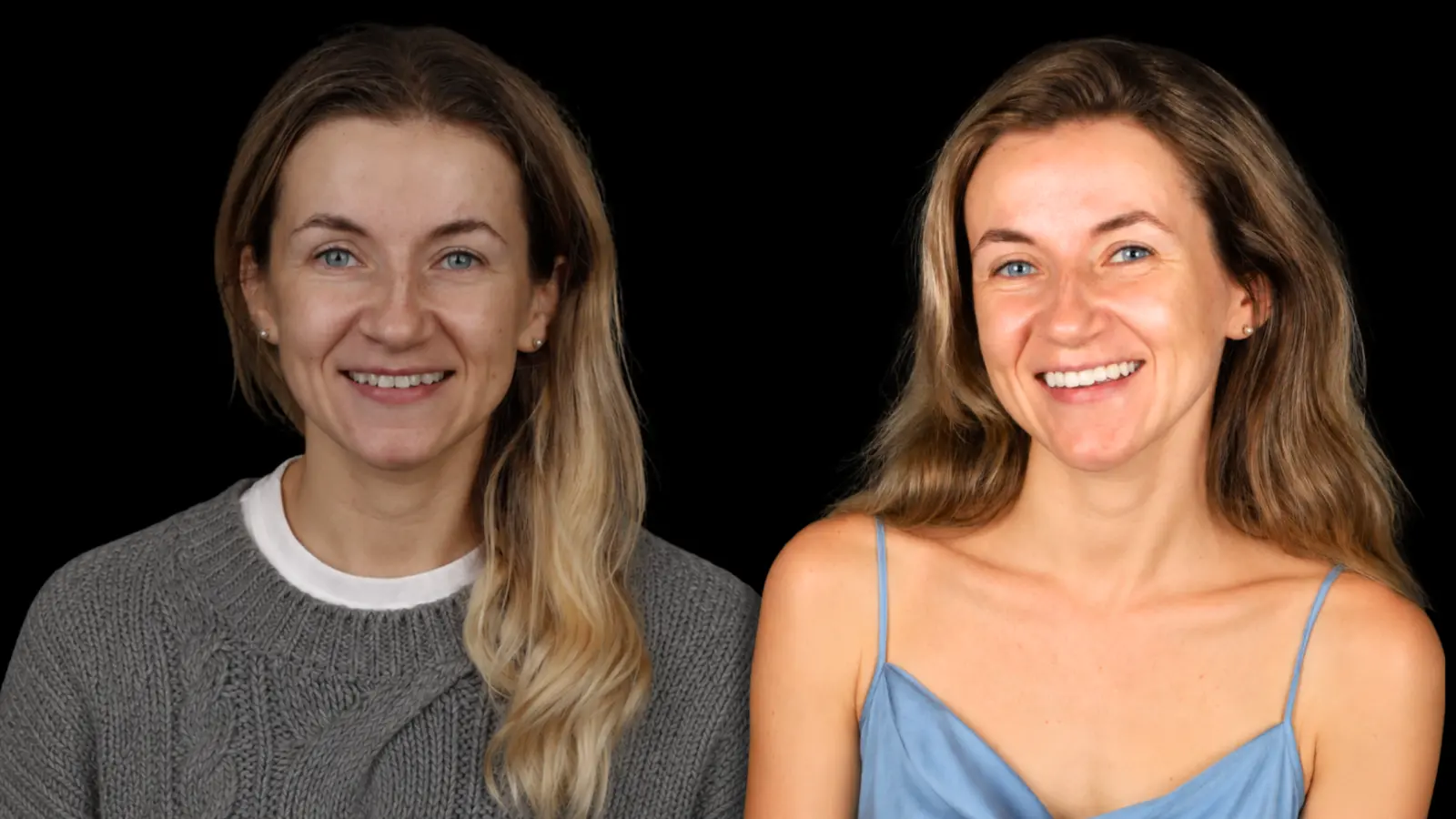
Diagnosis:
The patient presented with complaints of discolouration of her front teeth, numerous old composite restorations and an unsatisfactory smile. During the clinical examination, discolouration of the teeth was identified, along with restorations that had lost their functionality and aesthetic appearance.
Treatments:
Following digital planning, a decision was made to carry out aesthetic restoration of the upper incisors using refractive veneers. The restorations are made entirely from ceramic materials, without any metal framework, which is one of the most aesthetically pleasing techniques in modern dentistry. This method allows for the most accurate reproduction of the natural translucency, colour depth and optical properties of natural enamel, ensuring a flawless result.
Result:
Discolouration has been removed and old, unaesthetic restorations have been replaced. The natural shape, proportions and harmony of the front teeth have been restored. Thanks to refractive veneers, the patient achieved a natural, bright and aesthetically pleasing smile that closely mimics natural teeth, combining durability, functionality and premium aesthetics.
The clinic and service are of the highest standard – keep up the good work!
Ksenia Savenko
23.06.2026
I am very grateful to the whole FrankoLab team for the experience I’ve had with you. You are incredible! I wish you continued growth and prosperity, because the smiles you create are not only beautiful but also genuine, as seen on the faces of your grateful clients.
Would you like to whiten a tooth that has had its pulp removed? Book a consultation at FrankoLab Clinic — and find out whether internal tooth whitening is right for you.
Why people choose FrankoLab Clinic for in-office teeth whitening
01
Safe protocol with root canal protection
We always isolate the canal orifices before applying the medication — this is a standard that is by no means universally followed, yet it is crucial for the safety of the tooth. In addition, we carry out endodontic treatment under the guidance of an operating microscope and, if necessary, retreat the root canals immediately.
02
Modern teeth-whitening products
We use certified materials with a controlled concentration of the active ingredient — to ensure predictable results and minimise stress on the tooth structure.
03
Monitoring at every stage
We assess the results between sessions and adjust the number of repetitions on an individual basis — we don’t offer a ‘standard package’, but work to achieve the specific shade that suits you.
04
A full range of cosmetic dentistry services
From diagnosis and root canal preparation to endodontic bleaching, colour matching and the final aesthetic restoration of the tooth — we carry out everything in one place, under the coordination of a single team. There is no need to look for other clinics.
05
In-house digital laboratory and an aesthetic approach
After whitening a ‘dead’ tooth, it can be restored immediately using composite resin or other materials, taking into account the colour of the neighbouring teeth. The team focuses on achieving a natural and harmonious result.
06
Experience in treating complex cases of discolouration
Our specialists treat teeth that have darkened following trauma, previous root canal treatments and severe intrinsic staining. Our dentists tailor the number of sessions and treatment protocol to each individual patient to achieve the best possible whitening results.
Frequently asked questions about endodontic tooth whitening
No. A tooth without a nerve — a tooth that has had its pulp removed — is not sensitive to pain, so the procedure is carried out without anaesthesia and does not cause any pain. Some discomfort may only arise during procedures involving the gums or surrounding tissues — if necessary, the dentist will administer a local anaesthetic.
Usually 2 to 4 sessions, with a break of 3–7 days between each one. The exact number depends on the degree of pigmentation and the desired result. The dentist assesses the progress after each session and determines whether the next one is necessary.
A single whitening session for a root-canal-treated tooth lasts 20–40 minutes: the dentist removes the temporary filling, assesses the result, applies the whitening agent and seals the tooth again. The first session is sometimes slightly longer — due to the preparation and sealing of the root canals.
Provided the dentist follows the correct protocol and the patient adheres to the dentist’s recommendations, in-canal whitening is completely safe. The key safety measure is the isolation of the root canal orifices with a protective barrier, which prevents the bleaching agent from coming into contact with the filling material. Without this step, root damage is possible. At FrankoLab Clinic, this measure is a mandatory standard.
Hydrogen peroxide or carbamide peroxide in dental-grade concentrations are most commonly used, as well as a mixture of peroxide and sodium perborate. The dentist determines the choice of product and its concentration on a case-by-case basis, depending on the degree of discolouration and the condition of the tooth.
Yes, and this often produces the best results. If the teeth adjacent to a root-canal-treated tooth have darkened or yellowed, external whitening is carried out either at the same time as, or after, endodontic whitening to ensure an even colour across the entire dentition.
Provided the final filling is of high quality and regular oral hygiene is maintained, the result lasts from 3 to 7 years or longer. The tooth may darken again, but this is usually much less pronounced. If necessary, the procedure can be repeated.
If in-situ bleaching does not achieve the desired shade (for example, due to very deep or specific pigmentation), the dentist will suggest an alternative solution — the fabrication and fitting of a veneer or crown. These options make it possible to completely conceal discolouration and preserve the aesthetics of your smile.
When performed correctly, complications are rare. Possible complications include: slight gum sensitivity in the treated area; rarely, root resorption (as a long-term complication associated with the incorrect choice of preparation or a breach of protocol). This is precisely why it is important to entrust the procedure to an experienced dentist who adheres to modern clinical standards for internal tooth whitening.
Yes. The procedure is not carried out if root canals have been filled poorly (retreatment is required first), in the presence of active inflammation, significant destruction of the crown of the tooth, or if the root shows signs of resorption. We identify all contraindications during the consultation and diagnostic examination.
For the first 48 hours after each session, we recommend avoiding foods and drinks that stain easily (coffee, tea, red wine). Otherwise, care is standard: brushing twice a day, using a water flosser, and preventive check-ups every six months.
If in-situ bleaching is not recommended or does not produce satisfactory results, the following options are considered: a veneer — a ceramic shell that completely covers the colour of the tooth with minimal preparation; a crown — a full covering of the tooth for complex cases involving both decay and discolouration; enamel microabrasion — for superficial stains. The dentist selects the best option on a case-by-case basis.